Mosquito colonization across Wake County is largely driven by localized micro-habitats rather than open airspace. Properties in established, heavily wooded developments such as Preston, Lochmere, and MacGregor Downs…
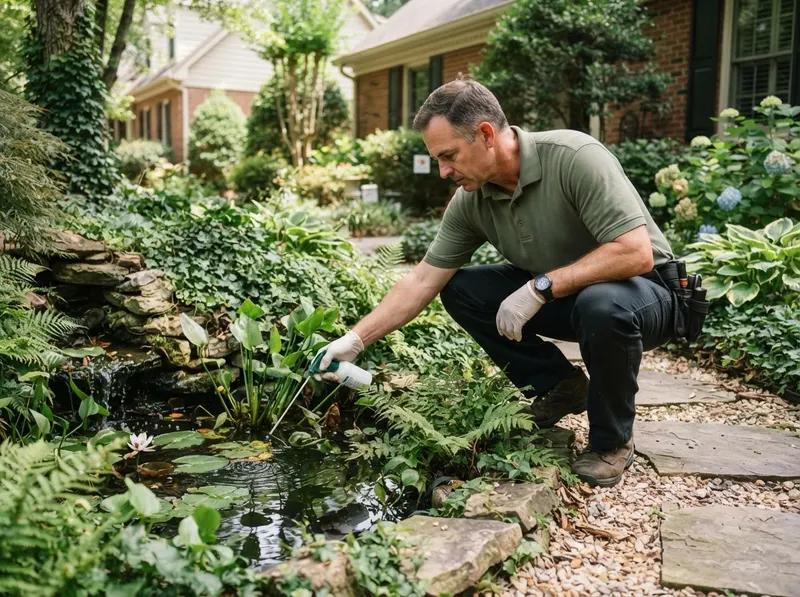
Mosquito colonization across Wake County is largely driven by localized micro-habitats rather than open airspace. Properties in established, heavily wooded developments such as Preston, Lochmere, and MacGregor Downs frequently collect natural moisture in low-lying grade depressions, mature tree cavities, and ground-level stormwater basins. When outdoor temperatures consistently exceed 50 degrees Fahrenheit, female mosquitoes deposit between 100 and 200 eggs at a time in stagnant film. Rather than saturating yards with indiscriminate adulticide thermal fog that disperses quickly and affects pollinators, targeted larvicide application disrupts the insect's life cycle at the instars stage. Biological agents such as Bacillus thuringiensis israelensis (BTI) introduce crystalline proteins that specifically disrupt mosquito digestive systems, leaving pets, beneficial insects, and soil ecosystems completely unharmed.
Dense community layouts and managed drainage systems in neighborhoods like Amberly, Wellsley, Twin Lakes, and Carpenter Village face distinct biological pressure points. Architectural features such as corrugated catch-basin extenders, landscape tiering, and clogged gutter transitions hold small volumes of stagnant water for over 72 hours, the minimum period necessary for larvae to reach adulthood. Properties bordering riparian buffer zones near Fred G. Metro Bond Park, Downtown Cary Park, or the tributary streams surrounding Koka Booth Amphitheatre experience consistent atmospheric humidity that shields adult insects in deep turf foliage. Effective intervention targets these specific structural reservoirs rather than applying broad retail aerosol treatments that fail to penetrate root barriers.
Property owners evaluating abatement options must weigh adult knockdown treatments against comprehensive larval suppression. Surface fogging provides immediate adult mortality for 24 to 72 hours but leaves millions of submerged eggs intact, resulting in re-infestation within days. Conversely, targeted habitat suppression with micro-pellet or briquette formulations sustains protection for up to 30 days per site by continually releasing active spores throughout the entire aquatic layer. While this protocol requires physically locating cryptic pooling areas beneath crawlspaces, deck undersides, and decorative planters, it reliably halts generational breeding cycles without requiring aggressive chemical saturation.
Every job gets a firm, written price after a free on-site visit.
Tell us about your mosquito habitat suppression & larvicide application job in Cary and we'll send a clear, written quote, usually the same day.
 PestHarbor Pest Control