Eastern subterranean termites enter structures through foundation settlement cracks as narrow as 1/32 of an inch, traveling from native Wake County clay soil through protective mud tubes directly into floor joists,…
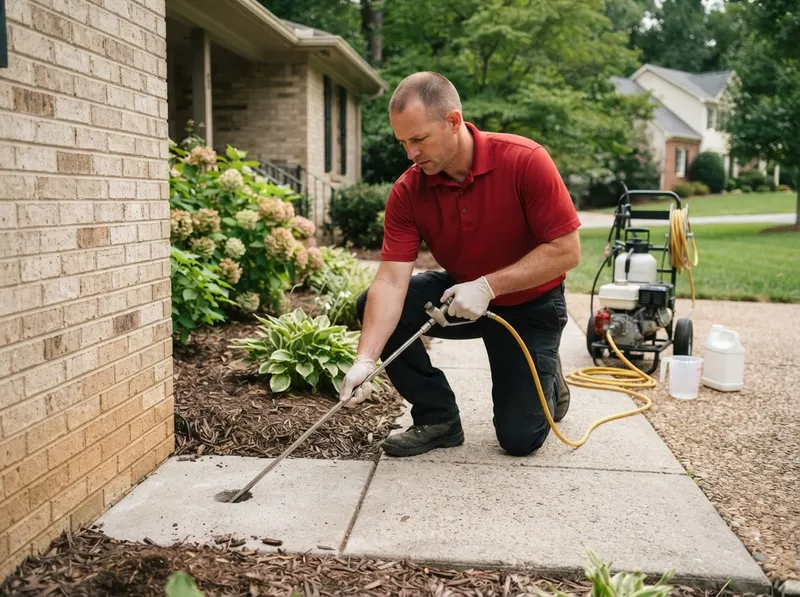
Eastern subterranean termites enter structures through foundation settlement cracks as narrow as 1/32 of an inch, traveling from native Wake County clay soil through protective mud tubes directly into floor joists, sill plates, and wall studs. In high-canopy neighborhoods such as Lochmere, MacGregor Downs, and Preston, heavy pine straw bedding, aged tree roots, and automated irrigation lines elevate sub-surface moisture adjacent to brick veneers and crawlspace vents. Liquid perimeter defense relies on non-repellent active agents, such as fipronil, which termites cannot detect. Workers tunnel through the treated barrier, ingest the compound, and transfer the lethal active agent throughout the subterranean colony via social grooming and mutual feeding, resulting in complete colony collapse within 60 to 90 days.
Subterranean termite soil treatment differs fundamentally from surface spray applications and standard bait stations. Injected trench barriers create an unbroken, chemically treated band of soil directly adjacent to the masonry foundation, providing continuous structural shielding that bait stations cannot guarantee during heavy reproductive swarming seasons near Fred G. Metro Bond Park and Hemlock Bluffs Nature Preserve. A bait system relies on random termite foraging to locate scattered plastic monitors, which can leave undetected gaps during early structural infiltration. The liquid trenching method saturates the immediate entry path; the trade-off is the physical labor requirement of clearing mulched perimeters, trenching 6 inches wide by 6 inches deep, and mechanically drilling finished slab areas such as attached garages or covered patios at 12-inch intervals.
Foundation construction dictates the application process across Cary developments. Monolithic slab foundations common in newer sections of Amberly and Carpenter Village require perimeter exterior trenching paired with precision interior slab drilling along shared plumbing penetrations. Older crawlspace homes in Wellsley and Twin Lakes require secondary interior trenching alongside foundation stem walls and structural support piers. To secure treatment, clear a 12-inch corridor of mulch, soil, and firewood away from exterior foundation brick prior to technician arrival. Direct all scheduling inquiries to (984) 306-0048.
Every job gets a firm, written price after a free on-site visit.
Tell us about your subterranean termite soil & perimeter treatment job in Cary and we'll send a clear, written quote, usually the same day.
 PestHarbor Pest Control